Implant Centers vs. Comprehensive Dental Care: What’s the Difference?
If you’ve been researching dental implants or full-arch tooth replacement, you’ve probably seen ads for large implant centers promising fast results and “teeth in a day.” You may also have heard your dentist talk about a more comprehensive approach to care.
To patients, these options can sound similar — but they are built on very different philosophies.
Understanding the difference can help you choose the type of care that’s right for you, especially for complex treatments like full-arch dental implants.
Two Different Models of Care
Implant Centers: Procedure-Focused Care
Implant centers are typically designed around one main service: placing dental implants. Their model is built for efficiency and volume.
They often emphasize:
• speed
• convenience
• same-day teeth
• set treatment packages
• centralized scheduling
• advertising-based patient flow
Their primary focus is the surgical procedure itself.
This can be appealing to patients who want a fast, simplified process.
Comprehensive Dental Care: Health-Focused Rehabilitation
A comprehensive dental practice looks at your mouth as a complete system — not just where implants can be placed.
This model emphasizes:
• long-term function
• bite balance
• aesthetics
• speech
• hygiene access
• maintenance
• coordination with your general dentist
The primary focus is the final result and how it holds up over time, not just the day of surgery.
Why This Difference Matters
Dental implants don’t work in isolation. They support teeth that must function every day when you eat, speak, and smile.
Long-term success depends on:
• how the teeth are designed
• how your bite fits together
• how forces are distributed
• how easy the restoration is to clean
• how your jaw joints respond
• how the materials wear over time
If treatment focuses only on placing implants, these factors can be overlooked or simplified.
A comprehensive approach plans the teeth first, then places the implants to support that plan.
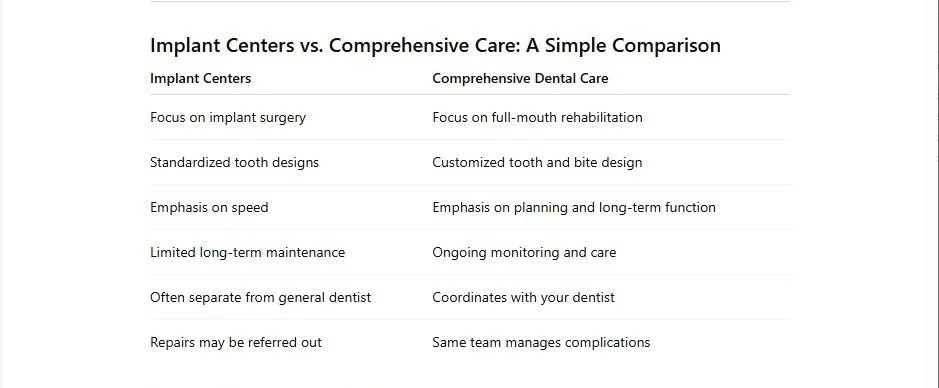
Both models can place implants. The difference is what happens before surgery — and after it.
Common Questions Patients Ask
“Aren’t all dental implants the same?”
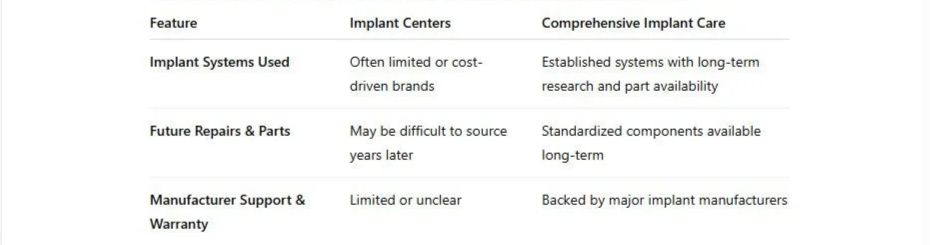
Many patients assume that all dental implants are the same — but just like cars or medical devices, implant systems vary widely in quality, support, and long-term reliability.
Some offices use lesser-known or private-label implant brands that may cost less upfront. While these implants can work in certain situations, they often come with important limitations:
Limited long-term research data
Fewer restorative component options
Difficulty finding replacement parts years later
Little or no manufacturer warranty
Less technical and clinical support for complex cases
By contrast, well-established implant systems from major manufacturers — such as Nobel Biocare — are backed by decades of clinical research, global availability, and strong restorative compatibility. This matters because dental implants are meant to last for decades, not just years.
If an implant or prosthesis ever breaks, loosens, or needs repair, access to standardized components and manufacturer support can make the difference between a simple fix and a complete redo.
“Why do prices vary so much?”
Lower-cost options often focus on:
• standardized prosthetics
• limited customization
• minimal follow-up
• fewer long-term services
More comprehensive care usually includes:
• detailed planning
• customized design
• multiple try-ins or prototypes
• long-term monitoring
• management of complications
• coordination with your dentist
The true cost of treatment is not just the initial price — it’s what happens if something breaks, wears out, or becomes uncomfortable later.
“Is one safer than the other?”
Both models can place implants successfully.
The difference is what happens:
• before surgery
• after surgery
• years later
Comprehensive care places more emphasis on:
• prevention of complications
• early detection of problems
• maintenance
• long-term stability
This can reduce the likelihood of needing major repairs later.
What Happens If Something Goes Wrong?
This is an important question many patients don’t think to ask.
With procedure-focused models:
• you may be referred elsewhere for repairs
• ongoing care may not be included
• responsibility may be divided between offices
With comprehensive care:
• the same team usually manages
– your implants
– your teeth
– your bite
– your long-term maintenance
This continuity can be important if adjustments or corrections are needed. For patients, the real question is not just “Can I get implants?” but:
“Will my implants still be serviceable 10 or 20 years from now?”
Choosing a provider who uses proven implant systems and plans for long-term maintenance can reduce the risk of future complications, costly replacements, and unexpected failures.
This is one of the reasons comprehensive implant practices focus not just on placing implants — but on designing restorations that can be repaired, upgraded, and maintained over time.
How Treatment Philosophy Affects Your Experience
In a Procedure-Focused Model:
You may experience:
• faster treatment
• fewer appointments
• standardized designs
• less customization
• limited long-term follow-up
In a Comprehensive Care Model:
You may experience:
• more planning appointments
• more discussion
• test phases for comfort and appearance
• adjustments over time
• ongoing maintenance visits
Neither is automatically “right” or “wrong.”
They simply serve different patient needs and expectations.
Which Approach Is Right for You?
Implant centers may be a fit if you:
• want the fastest possible process
• are comfortable with standardized solutions
• prefer a surgical-only focus
• do not need complex bite correction
• plan to manage long-term care elsewhere
Comprehensive care may be a better fit if you:
• want customized teeth
• care about long-term function
• have a history of dental problems
• grind or clench
• want one team managing everything
• value ongoing support
• want help if complications occur
Questions to Ask Any Provider
Before choosing where to have implant treatment, ask:
• Who designs my teeth?
• How is my bite planned?
• What materials will be used?
• How will my speech and comfort be evaluated?
• Who manages long-term maintenance?
• What happens if something breaks?
• Who do I call if I have a problem in 5 years?
The answers matter more than the brand name of the implants or how fast the surgery is done.
Our Philosophy
We believe replacing teeth should be treated as a long-term rehabilitation — not just a procedure.
That means:
• planning the final teeth first
• placing implants to support that plan
• designing for comfort, speech, and cleaning
• monitoring results over time
• helping patients if problems arise
Some patients come to us for their first implant treatment.
Others come because something didn’t work elsewhere.
Both deserve careful planning and honest guidance.
The Bottom Line
Implant centers and comprehensive dental practices approach tooth replacement differently.
One focuses primarily on placing implants.
The other focuses on rebuilding how your mouth functions over time.
If you are considering dental implants — especially full-arch treatment — take time to understand which model aligns with your goals, expectations, and comfort level.
Your smile is not just a procedure.
It’s part of your daily life.
And how it’s designed matters.